Definition
A lift is a permanently installed appliance that serves defined levels and moves a car along guide rails, to carry people, or people and goods. It can be installed inside a building or outside, in a masonry shaft or in a steel structure.
In Europe, building lifts fall under the Lifts Directive 2014/33/EU and are built to the EN 81-20 and EN 81-50 standards. Low-speed home lifts fall under the Machinery Directive.
The main components
- The car, which carries the users, and its sling, guided by rails along the shaft.
- The machine: an electric motor, with or without gearbox, or a hydraulic power unit with its ram.
- The counterweight, on electric traction lifts: it balances the car and reduces the power needed.
- The controller, the brain of the lift: it registers calls, knows the car position and drives the machine and the doors.
- The landing doors, which close off access to the shaft, and the car doors.
- The safety devices: overspeed governor, safety gear, buffers, door locks and safety chain.
How it works
The user presses a call button. The controller registers it, decides which car answers and in what order, and gives the run command to the machine. A positioning system tells it at all times where the car is, so it can slow down and stop level with the landing. The doors only open when the car is stopped in the unlocking zone, and the lift only starts if all safety devices are closed.
Types of lift
Electric traction
The most widespread. Car and counterweight hang from ropes or belts that run over the sheave of an electric machine. It is fast, efficient and suited to long travel. It comes in two layouts:
- Machine-room-less (MRL): the gearless motor is in the shaft itself and the controller on a landing. No machine room to build.
- With machine room (MR): machine and controller are grouped in a machine room, usually above the shaft. Common for replacements and in tall or heavily used buildings.
Hydraulic
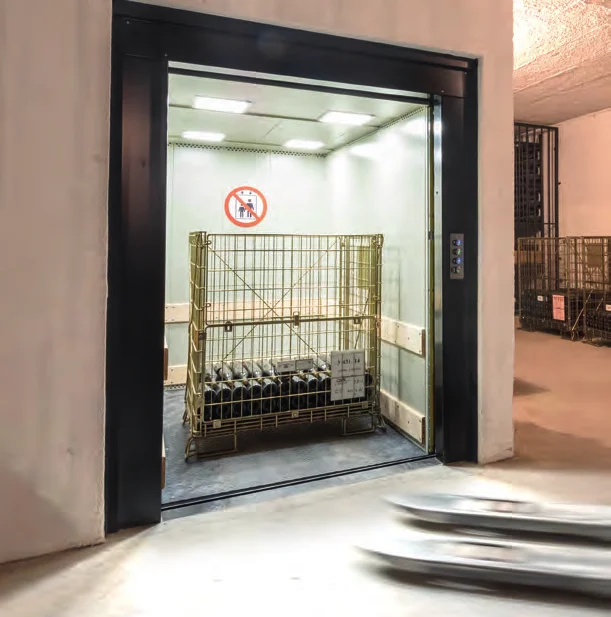
A ram, fed by an oil power unit, pushes the car. It is very stable with heavy loads, but its travel and speed are limited. It is used mainly for goods lifts and low-rise buildings.
Home lifts
Designed for houses and villas: low speed, minimal pit and single-phase supply. Installed in a masonry shaft or a self-supporting structure, inside or outside the home.
Why install a lift
- It makes every floor accessible, including for people with reduced mobility, pushchairs and wheelchairs.
- It makes it easier to move goods and for emergency services to intervene.
- It adds value to the building and makes better use of land by building upwards.
- With regular maintenance, a lift stays in service for decades.