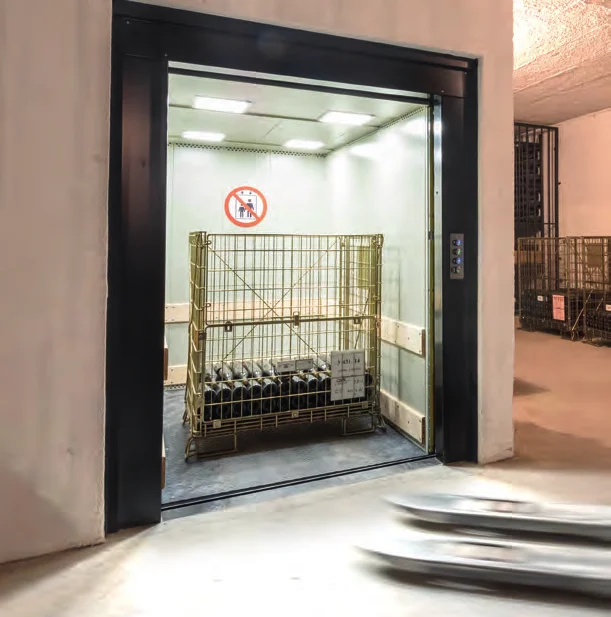
1. Intended use
This is the first criterion, and it shapes all the others. Ask yourself:
- How often will it be used: a few times a week or continuously?
- What weight and volume will the loads have?
- Is it for industry, a warehouse, a shop, a hospital or a residential building?
- Will people travel with the load?
In industry, logistics or healthcare, where continuity of service is essential, robustness and spare-part availability count as much as price.
2. Load and area
The rated load and the area of the platform or car are linked. Count not only the weight of the goods, but also that of the handling equipment: a pallet truck or a forklift enters the car with its load. For heavy loads, such as those of the Megalift, mechanical locking stops are also provided at each floor for the loading phases.
3. Travel
Travel is the distance between the lowest and highest stops. Some systems, such as hydraulic rams, have limited travel: check before choosing the technology.
4. Drive: electric or hydraulic
Electric traction suits long travel and heavy traffic. Hydraulics offer great stability for heavy loads over short travel, especially with forklift loading. Our article on electric or hydraulic lifts details the differences.
5. Applicable regulations
In the European Union, the rules depend on the appliance:
- If the car is accessible to people, even only for loading and unloading, the appliance is a lift within the meaning of Directive 2014/33/EU and must comply with EN 81-20 and EN 81-50.
- Small goods lifts not accessible to people, such as service lifts, and certain low-speed appliances fall under the Machinery Directive 2006/42/EC.
Outside Europe, these standards often serve as a reference. Always ask for the declaration of conformity and the certificates of the safety components.
6. Environment
Cold, humidity, dust, food industry, outdoor installation: the environment determines materials, protection of electrical equipment and the type of doors. Mention it from the start.
7. Installer and service
A badly installed goods lift can be out of service for long periods. Choose an installation company that knows the equipment well, ask for references from similar projects and make sure maintenance and spare parts will be available throughout the life of the lift.