Why a drive
On a two-speed controller, the car switches from one speed to the other: the change can be felt. A frequency drive varies the speed continuously. Starting and stopping are gradual, levelling accuracy is better and the machine wears less.
It is also what makes gearless possible: a machine without a gearbox cannot run without electronic speed control.
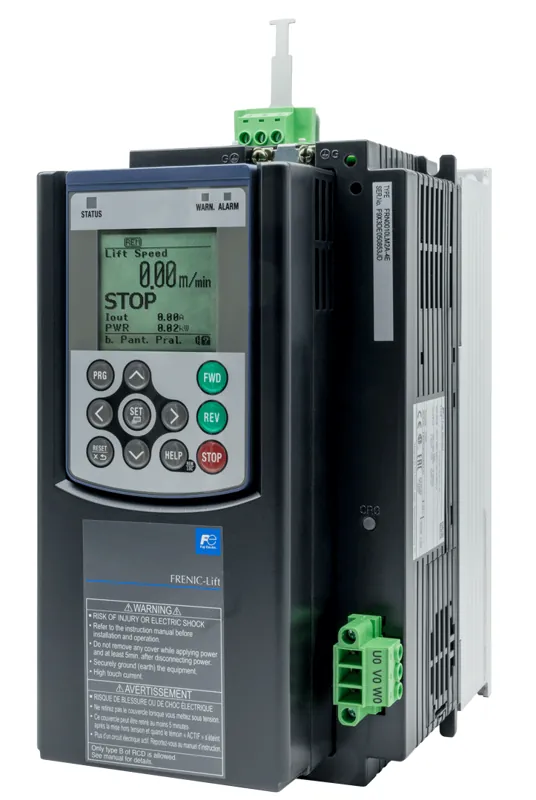
Fuji FRENIC Lift: the rescue is in the lift
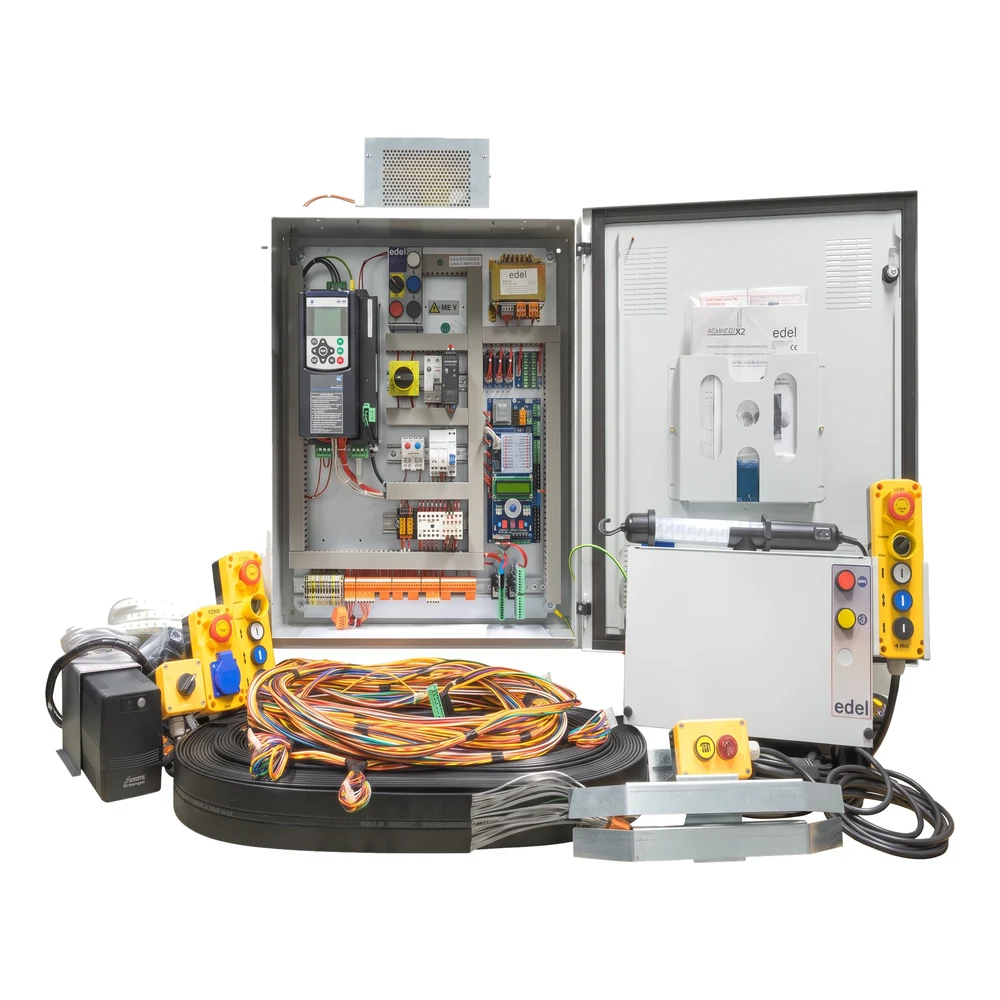
It is the drive around which Edel built its documentation: in the installation manuals, wiring is described with a Fuji FRENIC Lift, both in the 3VF manual and in the gearless manuals.
Its decisive advantage is automatic rescue. In a power cut, the controller brings the car to the nearest landing by itself and opens the doors, on its emergency supply (the UPS that Edel diagrams show at the drive input).
Second advantage: it works with both geared and gearless machines. One drive and one set-up logic, whatever the machine.
Yaskawa: the rescue depends on the building
The Yaskawa is specified in particular cases: installations with a machine room, for its value for money.
But it does not provide automatic rescue. In a power cut, bringing the car back to a landing no longer depends on the lift but on an emergency supply in the building: a generator, a UPS or a safety switchboard.
That is where the real decision is made. If the building has a reliable emergency supply, the Yaskawa does the job for less money. If it does not, or if it is not guaranteed, a power cut leaves the car between two floors, with its occupants.
The decision table
| Fuji FRENIC Lift | Yaskawa | |
|---|---|---|
| Automatic rescue | Built into the lift | No, provided by the building |
| Geared machine | Yes | Yes |
| Gearless | Yes | Depending on configuration |
| Machine room | With or without | Usually with |
| Cost | Higher | Better value for money |
| Edel documentation | 3VF and gearless manuals | Outside the manuals |
In other words: the extra cost of the Fuji buys independence from the building. It is a safety decision before it is a price decision.
Reading a controller designation
Three values matter in the designation of a controller with a drive: the voltage (400 V or 230 V), the current in amps and the motor power in kilowatts. All three are read on the motor rating plate; they cannot be deduced from the rated load or the number of floors.
Settings are not copied
A drive is not a part you replace and forget. The K2 643VF manual devotes a whole chapter to set-up: auto-tuning on the installed motor, adjusting the characteristic curve and configuring the parameters.
Auto-tuning makes the drive measure the real characteristics of the motor it is connected to. Copying the parameters of another lift as they are, even an identical one on paper, gives poor ride comfort and worse levelling accuracy. This commissioning is the technician's job.